
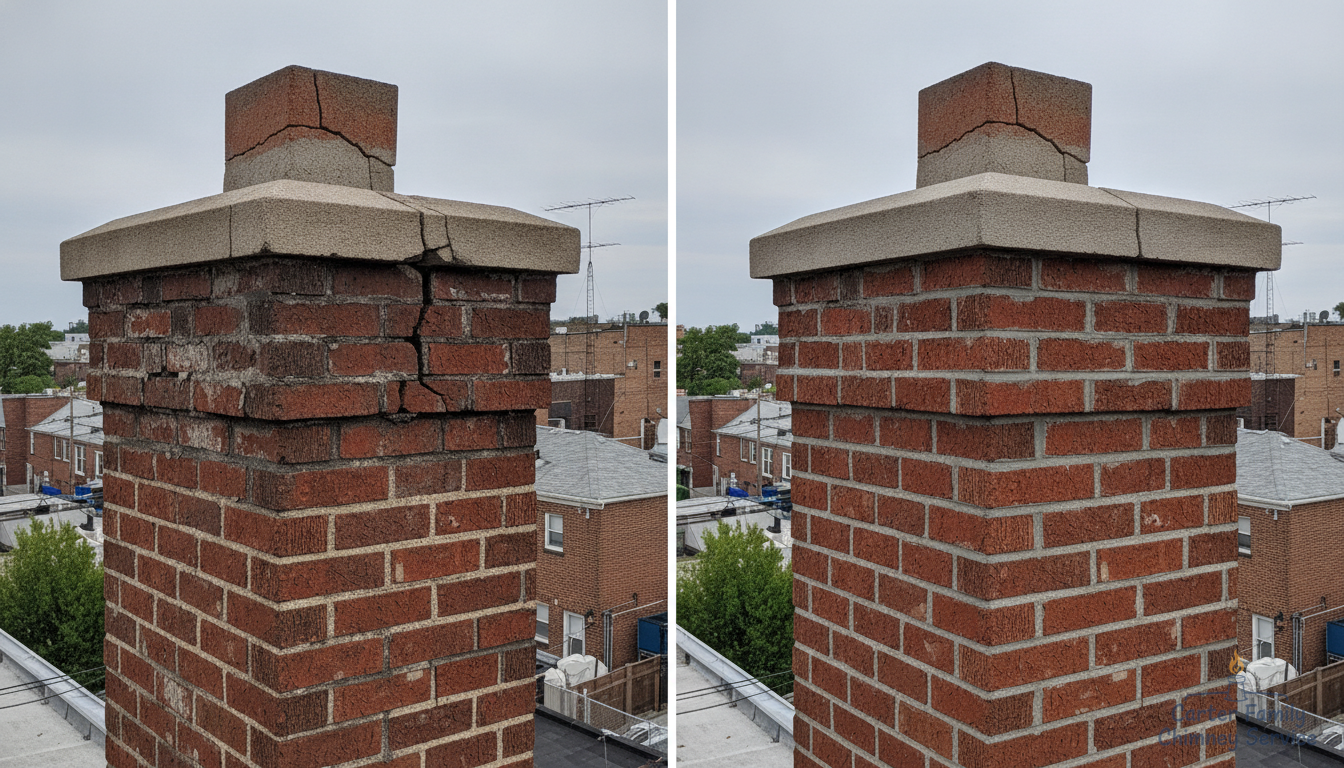
Why Water Is Your Chimney's Biggest Enemy
When most homeowners think about chimney hazards, they think about fire — and that concern is well-founded. But in the South Richmond Hill area, water infiltration is actually responsible for more chimney damage dollar-for-dollar than any other single cause. New York's climate delivers heavy rain, repeated freeze-thaw cycles through the winter months, and summer humidity that keeps masonry materials perpetually stressed. The two most important components protecting your chimney from water are the chimney crown and the mortar joints between the bricks — and both are among the first elements to deteriorate on an aging chimney stack.
Understanding the Chimney Crown
The chimney crown is the concrete or mortar slab that caps the top of your masonry chimney. It is designed with a slight downward slope away from the flue liner so that rainwater sheds off the stack and away from the brickwork below, rather than pooling around the flue opening and soaking into the masonry. A properly built crown extends past the edges of the chimney face with a slight overhang, creating a drip edge that keeps water clear of the upper brick courses.
In reality, many Queens-area chimneys were originally crowned with thin, inadequately reinforced mortar slabs that crack and crumble within a decade or two of installation. Once cracks form in the crown — especially in the New York freeze-thaw environment, where water enters hairline cracks and expands as it freezes — the deterioration accelerates rapidly. Water that penetrates the crown reaches the flue liner, the smoke chamber, and eventually works its way down into the firebox and the surrounding masonry.
Carter Family Chimney Service assesses crown condition during every chimney inspection. For crowns with minor surface cracking, we apply flexible elastomeric crown sealants that create a waterproof membrane and flex with thermal expansion. For crowns that have lost structural integrity — sections missing, deep cracks reaching the brick face, or an originally undersized design — our technicians form and pour a fully reinforced replacement crown with the correct overhang dimensions, finished with a penetrating masonry water repellent. Learn more about our complete chimney crown repair service.
What Is Tuckpointing and When Is It Needed?
The mortar joints between the bricks of your chimney stack serve two critical functions: they bond the bricks together structurally and they seal the wall surface against water penetration. In pre-1950s construction throughout Richmond Hill, Woodhaven, and South Richmond Hill, these joints were typically made with soft lime-based mortar that, while durable when intact, erodes gradually with decades of weather exposure. Mid-century and newer construction used harder Portland cement-based mortars, which weather differently but are equally susceptible to deterioration over time.
Tuckpointing is the process of carefully grinding out the deteriorated mortar to a uniform depth — typically at least three-quarters of an inch — and repacking the cavity with fresh mortar matched to the original composition and color. This restores both the structural bond between the bricks and the waterproof integrity of the joint surface. Tuckpointing done with correctly matched mortar hardness can add 20 to 30 years of serviceable life to a chimney that would otherwise require expensive partial or full rebuilding.
Here are the most common signs that your chimney mortar joints need professional tuckpointing:
- Mortar joints that appear visibly recessed, crumbling, or missing between brick courses
- White mineral staining (efflorescence) on the brick face, indicating water is migrating through the masonry
- Loose or rocking individual bricks anywhere on the chimney stack
- Water appearing inside the firebox or on the hearth floor after rainfall
- Spalling bricks with flaking or pitting surface faces — a sign that freeze-thaw cycling is already damaging the masonry
Our tuckpointing and mortar repair service uses professional angle grinders with dust collection to prepare joint cavities cleanly before packing them with mortar formulated to match your chimney's original hardness and color profile. Using the wrong mortar hardness — a common DIY mistake — can cause the surrounding bricks to crack and spall rather than protecting them.
Crown Repair and Tuckpointing: A Complete Waterproofing Solution
Crown repair and tuckpointing are most effective when performed together as part of a comprehensive chimney waterproofing program. A new or sealed crown prevents water from entering at the top, while freshly tuckpointed joints seal the entire face of the stack against driving rain and moisture absorption. Once both repairs are complete, our technicians can apply a penetrating masonry water repellent to the full chimney surface — a breathable treatment that allows trapped moisture vapor to escape while blocking new liquid water from entering the brick and mortar pores.
If a chimney inspection reveals that water has already penetrated deeply enough to damage the flue liner, we can assess whether chimney liner installation or relining is needed to restore safe venting. Catching crown and mortar deterioration early, before water reaches the liner or interior structure, is always far more cost-effective than repairing the downstream damage.
Service Areas for Chimney Waterproofing in Queens
Carter Family Chimney Service provides chimney crown repair in South Richmond Hill and tuckpointing in South Richmond Hill, as well as across the surrounding Queens neighborhoods we serve every week. Our service area includes Richmond Hill, Ozone Park, Woodhaven, Jamaica, Kew Gardens, and Howard Beach. We are available Monday through Sunday from 8:00 AM to 6:00 PM to accommodate your schedule.
To schedule a chimney inspection and waterproofing assessment, contact Carter Family Chimney Service at (929) 356-7855 or email [email protected]. Protecting your chimney from water damage today is the most cost-effective maintenance decision you can make as a Queens homeowner.
Confirm Availability
Call +19293567855 or fill out our online form for a free, no-obligation quote.
Request Free Quote